
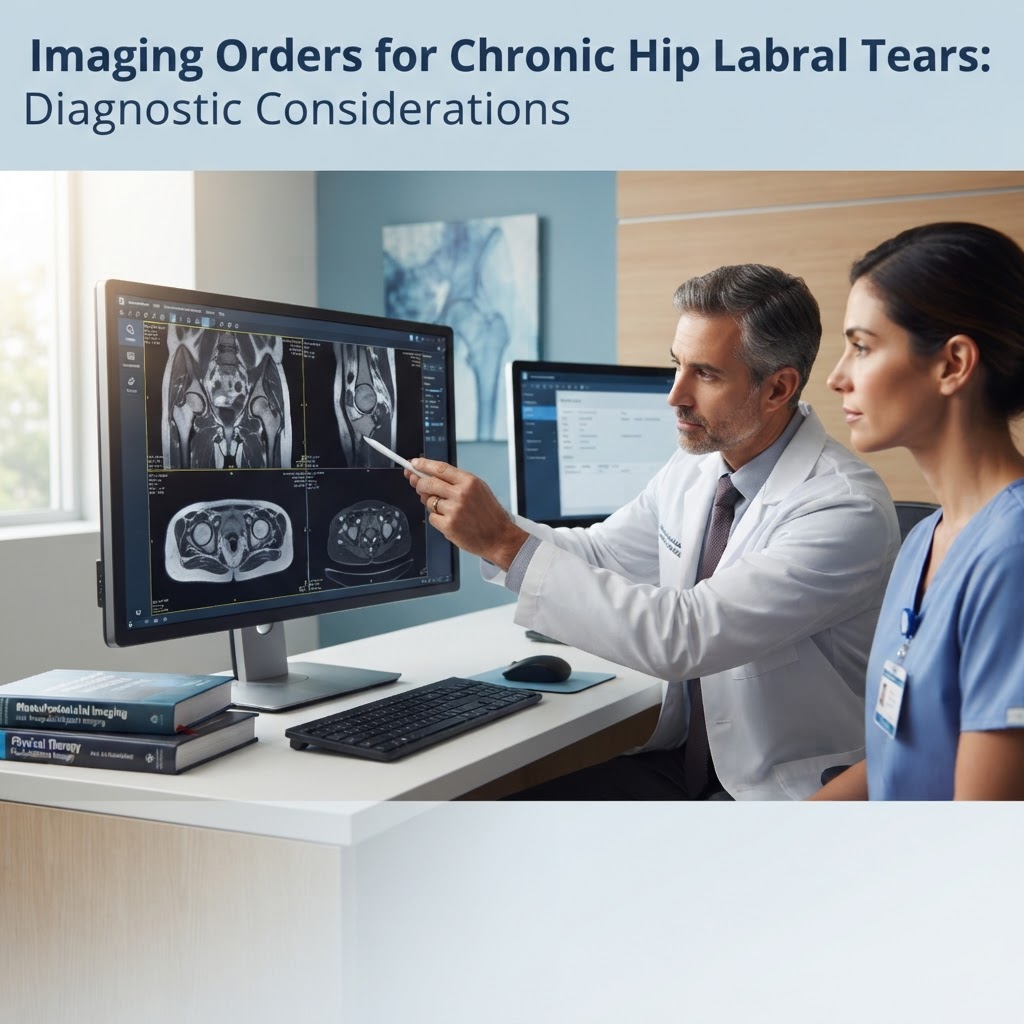
Imaging Orders for Chronic Hip Labral Tears: Diagnostic Considerations
Persistent hip pain can be a frustrating obstacle to daily activity. Whether you are an athlete dealing with sharp, catching sensations or an individual noticing a dull ache that refuses to subside, understanding the source of your discomfort is the first step toward recovery. Two of the most common, yet frequently confused, culprits are hip labral tears and trochanteric bursitis.
Differentiating Labral Tears from Bursitis
While both conditions cause hip pain, their origins and clinical presentations differ significantly. Hip bursitis (trochanteric bursitis) involves inflammation of the fluid-filled sacs that cushion the hip joint. Patients with bursitis typically experience pain on the outside of the hip, especially when lying on that side or walking up stairs. It is often described as an ache that is tender to the touch.
Conversely, a hip labral tear involves the labrum—the ring of cartilage that follows the outside rim of the socket of your hip joint. This condition often presents differently:
- Location: Pain is usually deep in the groin or front of the hip.
- Sensation: Many patients report a locking, clicking, or catching sensation when moving the leg in certain ways.
- Triggering Movements: Pain is frequently exacerbated by prolonged sitting, pivoting, or sudden changes in direction.
If your pain feels deep within the joint rather than superficial on the outer hip bone, a labral pathology may be the suspected source.
The Gold Standard: Why MRI Arthrograms Matter
A standard MRI is often the first step in orthopedic imaging, but it is not always sensitive enough to detect small tears in the hip labrum. Because the labrum is thin and surrounded by complex anatomy, specialists often prefer an MRI arthrogram.
An MRI arthrogram involves injecting contrast dye directly into the hip joint before the imaging scan. This process distends the joint capsule, allowing the radiologist to see the thin edges of the labrum in much higher detail. If you have been struggling with deep hip pain that does not respond to initial interventions, discussing an MRI arthrogram with a provider is a logical next step to obtain a clear diagnosis.
Moving Beyond Conservative Care
For many, the path to recovery starts with physical therapy. If you have completed a guided course of physical therapy without seeing significant improvement, or if your pain is worsening, it is time to reassess your diagnostic strategy. Persistent pain after conservative management is a strong indicator that internal structural damage may be present.
If you find yourself waiting for a specialist appointment or struggling to get an order through your current system, you may consider a virtual evaluation. At Diagnostic Orders Direct, we provide $40 virtual provider reviews for imaging and lab order requests. Our licensed U.S. providers assess your clinical history to determine if an imaging order is medically appropriate for your specific situation.
Preparing for Your Telehealth Consultation
To make the most of a telehealth consultation for hip pain, come prepared with a clear timeline of your symptoms. Be ready to discuss:
- When the pain began and any specific injury that preceded it.
- Which movements make the pain better or worse (e.g., squatting, sitting for long periods).
- Any prior treatments attempted, such as physical therapy, anti-inflammatory medications, or rest.
- Your current mobility levels and how the pain impacts your daily tasks.
Having this information readily available allows the provider to evaluate your case efficiently and determine the most appropriate next steps for diagnostic imaging.
Taking the Next Step
Navigating healthcare can be complex, especially when you are managing chronic pain. Whether you are dealing with a potential labral tear or another structural issue, getting the right diagnostic order is crucial for your treatment plan. Diagnostic Orders Direct is here to support your health journey by offering a streamlined way to request diagnostic imaging orders when medically indicated. Learn more about how we serve patients in 36 states and D.C. by visiting https://diagnosticordersdirect.com.
Important Disclaimer
Diagnostic Orders Direct is not an imaging center, laboratory, radiology service, or emergency service. If you are experiencing a medical emergency, please call 911 or visit your nearest emergency room immediately. Orders are not guaranteed and are issued only when determined to be medically appropriate by our licensed providers after a virtual consultation. This service is not a replacement for comprehensive primary care or a long-term patient-provider relationship.