
Imaging Orders for Chronic Plantar Fibromatosis: Diagnostic Considerations
Persistent foot pain often leads patients to assume they are suffering from plantar fasciitis. While inflammation of the heel cord is the most common cause of foot discomfort, it is not the only culprit. For some, the pain stems from small, firm nodules along the arch, a condition known as Ledderhose disease, or plantar fibromatosis.
Distinguishing Symptoms: Fibromatosis vs. Fasciitis
While plantar fasciitis typically presents as sharp, stabbing pain near the heel—often worse with the first steps in the morning—plantar fibromatosis presents differently. Patients with fibromatosis often feel a palpable lump or firm mass within the deep tissues of the medial arch. Unlike the diffuse tenderness of fasciitis, these nodules may be focal and become more painful when wearing tight-fitting shoes that apply direct pressure to the area.
The Role of High-Frequency Ultrasound
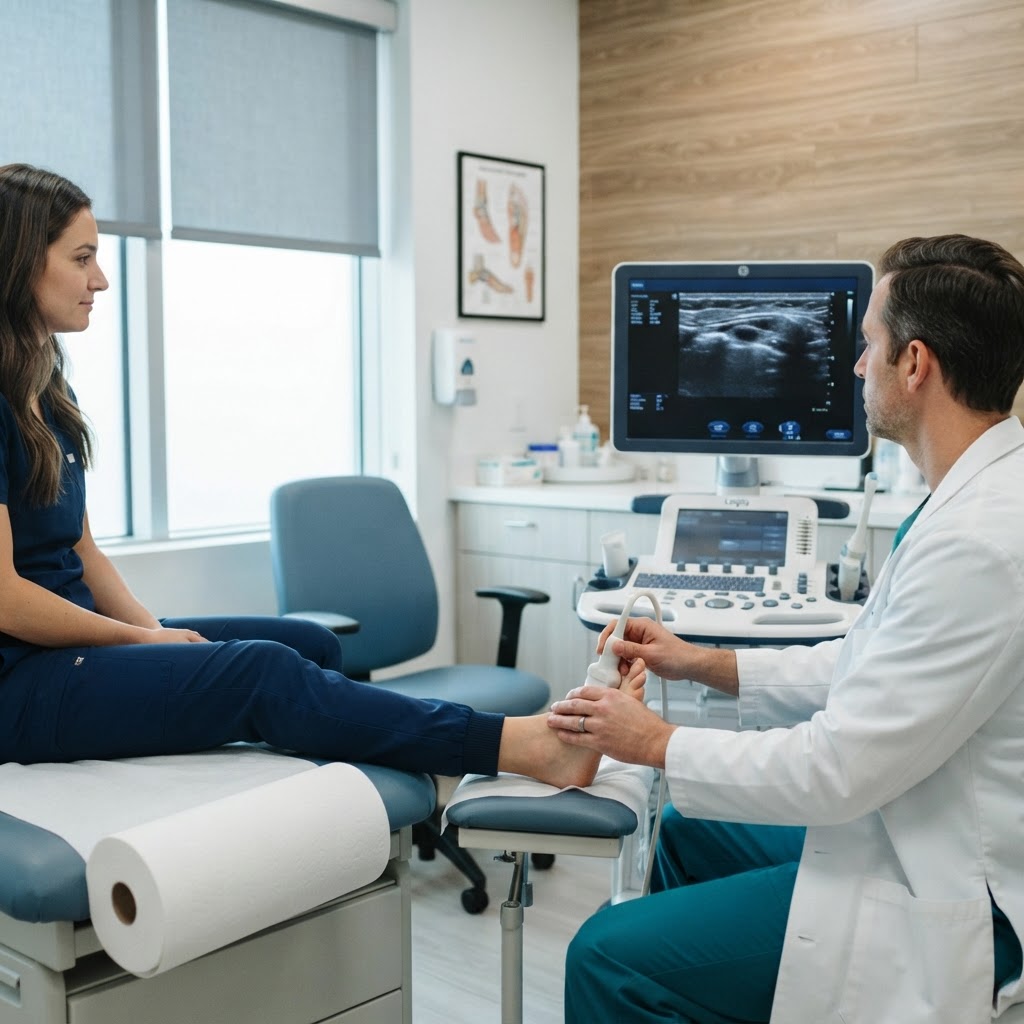
When a patient presents with a suspicious nodule in the foot, high-frequency diagnostic ultrasound is often the first-line imaging choice. Ultrasound is particularly effective for evaluating superficial soft tissue structures. It allows a provider to identify the hypoechoic (darker) or mixed-echoic masses characteristic of fibromatosis. Ultrasound imaging helps confirm that the mass is indeed a fibroma and helps differentiate it from a ganglion cyst or other benign soft tissue growth.
When to Consider an MRI
While ultrasound is an excellent screening tool, it has limitations. If a nodule appears rapidly, demonstrates aggressive growth, or shows irregular internal blood flow, a provider may escalate the diagnostic pathway to an MRI. An MRI provides superior contrast resolution, allowing for a detailed look at the relationship between the mass and the underlying tendons or bone. This is essential for ruling out rarer, more serious conditions such as malignant soft tissue sarcomas, though these are significantly less common than benign fibromatosis.
Simplifying the Imaging Request Process
Securing a diagnostic order shouldn't be a source of stress. Whether you lack a primary care provider, are facing high insurance barriers, or are tired of waiting for specialist referrals, Diagnostic Orders Direct offers a streamlined solution. We provide $40 virtual provider reviews for imaging order requests, including ultrasound and MRI, to help you get the diagnostic answers you need. If a licensed provider determines that imaging is medically appropriate based on your symptoms, they can issue the necessary order for your preferred facility. Visit Diagnostic Orders Direct to learn more about how we facilitate this process.
Taking Control of Your Foot Health
If you have noticed a persistent lump in your foot arch, it is time to move beyond guesswork. Obtaining a diagnostic order allows you to see the true nature of the tissue growth, guiding your next steps in treatment—whether that involves physical therapy, orthotics, or other clinical interventions. Don't let localized foot tissue concerns linger; seek the imaging you need to move forward with clarity.
Important Disclaimer
Diagnostic Orders Direct is not an imaging center, laboratory, or emergency service. This service is not for medical emergencies; if you are experiencing a life-threatening health event, call 911 or visit the nearest emergency room immediately. Orders are not guaranteed and are issued only when determined medically appropriate by a licensed provider. Our services are intended to support diagnostic decision-making and are not a replacement for a primary care provider or ongoing specialist medical management.